




The Missing Piece in Weight Loss Most People Overlook: Your Mindset
/
Weight loss can feel complicated.
There is so much information out there about what to eat, how much to exercise, how many calories to consume, which foods to avoid, which diet is best, and what you should be doing if you want to see results. And just when you think you've figured it out, there's another diet, another strategy, or another expert telling you to do something completely different.
The funny thing is, most of us already know many of the basics. We know that eating nutritious foods matters. We know that movement is important. We know that sleep, hydration, stress and our daily habits all play a role. And yet, so many people find themselves saying:
"I know what to do. I just don't do it."
That's where I think we need to look at something beyond the food and the exercise.
Because sometimes the missing piece isn't more information.
It's your mindset.
The way you think about yourself, your goals, your body, your habits and your ability to change can influence the choices you make every day. And those choices, repeated over time, become your behaviors. This is where mindset meets wellness—and where things can start to shift.
You Are Always Practicing Something
One of the ideas I come back to again and again with my clients is this:
You are always practicing something.
Every day, you're practicing the way you think, the way you respond, and the behaviors you repeat.
If you repeatedly tell yourself:
"I can't stick with anything," you're practicing that thought.
I'm terrible at losing weight," you're practicing that thought.
If you repeatedly skip the habits you say are important to you, you're practicing that behavior too.
But the opposite is also true.
When you practice preparing a balanced breakfast, you're reinforcing that behavior.
If you practice stopping to check in with your hunger before you eat, you're building awareness.
When you practice getting your walking shoes on every morning, you're reinforcing movement as part of your routine.
Maybe you practice speaking to yourself in a way that supports you instead of tearing you down, you're practicing a new way of thinking.
What you consistently practice on a day-to-day basis leads to the behaviors that you form.
And that means we want to pay attention to what we're practicing.
Your Brain Learns Through Repetition
Your brain is designed to learn from repetition.
When you repeatedly think, behave, or respond in a certain way, those patterns become more familiar. This is part of what we mean when we talk about neuroplasticity—the brain's ability to adapt and change by forming and strengthening neural connections.
Think about something you do every day without really thinking about it. Maybe it's making your coffee in the morning. Maybe you automatically check your phone when you wake up. Maybe you always take the same route to work.
You don't have to consciously think through every step because you've practiced the behavior so many times.
The same thing can happen with our health habits and our thought patterns. The more we practice something, the more familiar it becomes.
This is why I don't want you to think about mindset as something you simply "have" or "don't have."
Mindset is something you practice.
And if you can practice one way of thinking, you can practice another.
Pay Attention to the Stories You Tell Yourself
Think about some of the things you say to yourself about your health or weight.
"I always get stuck at this weight."
"I've tried everything."
"I have no willpower."
"I can never stay consistent."
"I'm just not someone who exercises."
"I always fall off track."
These thoughts might feel like facts because you've thought them so many times. But a thought you've practiced for years isn't necessarily a permanent truth. It's a story you've become familiar with.
And this doesn't mean you should replace every difficult thought with something overly positive that you don't believe. I'm not interested in telling yourself, "Weight loss is easy!" if that's not how you feel.
Instead, start with something that feels believable and opens the door to another possibility.
Instead of:
"I always get stuck at this weight."
Try:
"I've struggled at this weight before, but I'm open to finding a different way forward."
Instead of:
"I can't stay consistent."
Try:
"Consistency has been difficult for me, and I'm learning what helps me maintain it."
Instead of:
"I have no willpower."
Try:
"I'm learning which habits and routines make healthy choices easier for me."
That's not toxic positivity. In fact, I always want you to acknowledge the hard. That's important too. It's simply giving yourself a different thought to practice.
Your Thoughts Can Influence What You Notice
There's another reason this matters. What you're focusing on grows.
When you consistently focus on everything that isn't working, it's easy to overlook the things that are. If your only measure of success is the number on the scale, you may miss the fact that you're eating more protein, walking more often, sleeping better, feeling stronger, or making different choices around food.
If you're constantly telling yourself that you can't lose weight, you may be less likely to notice opportunities to try something different.
Maybe your meals need to change.
Your sleep needs attention.
You could be under-eating during the day and finding yourself ravenous at night.
Maybe your stress is affecting your hunger and cravings.
Your body composition is changing even though the scale isn't moving.
You simply need to approach your routine differently.
When you're locked into the story that "this never works for me," it can be difficult to see the possibilities that exist outside of that story.
Changing your thoughts doesn't magically change your physiology.
But it can change what you're paying attention to, the choices you're willing to make, and the possibilities you're willing to consider.
Weight Loss Isn't Just About Changing Your Habits
I often talk about the connection between identity and behavior because the two influence each other.
It's easy to think:
"When I lose the weight, then I'll become the person who eats well, exercises regularly and takes care of herself."
But what if you started practicing those behaviors now? Not perfectly. Not all at once. Just little by little.
Ask yourself:
Who do I want to be?
How does that person take care of herself?
What does she practice on a regular basis?
What choices would support the life and health she wants?
Maybe that means preparing breakfast instead of skipping it, getting your Fitbit on every morning because that simple action reconnects you to your goals, going for a walk after dinner, learning to recognize when you're physically hungry or speaking to yourself differently after a day that didn't go as planned.
These might seem like small things. But small things repeated consistently are what become behaviors. And behaviors are what create real change.
Your Mindset Is Part of Your Wellness
Your mindset isn't separate from your health. The way you think influences the choices you make. The choices you make repeatedly become behaviors. And those behaviors become part of your everyday life.
That's why I don't believe lasting weight loss is simply about finding the perfect meal plan or the perfect workout.
Those things can absolutely be useful tools. But they're only part of the picture.
The other part is learning how to notice what you're thinking, understand the patterns you're practicing, and become more intentional about the thoughts and behaviors you want to reinforce.
Taking The First Step
You don't have to change everything today.
Start by noticing.
Choose one thing you want to practice.
Practice it consistently for 1-2 weeks.
As you practice - get curious about what you notice. What’s going well? What isn’t? What feels comfortable for you?
Sometimes the biggest changes begin with something that looks incredibly small. And sometimes, the most powerful shift is simply realizing that you have the ability to practice something different.
Keep Going: Your Next Steps
Want to dive deeper? Here are a few resources to keep the momentum going:
📌 Related Posts
Weight Loss Mindset: Shift Your Thoughts & Beliefs for Weight Loss Success
7 Day Mediterranean Diet Meal Plan for Weight Loss & Wellness
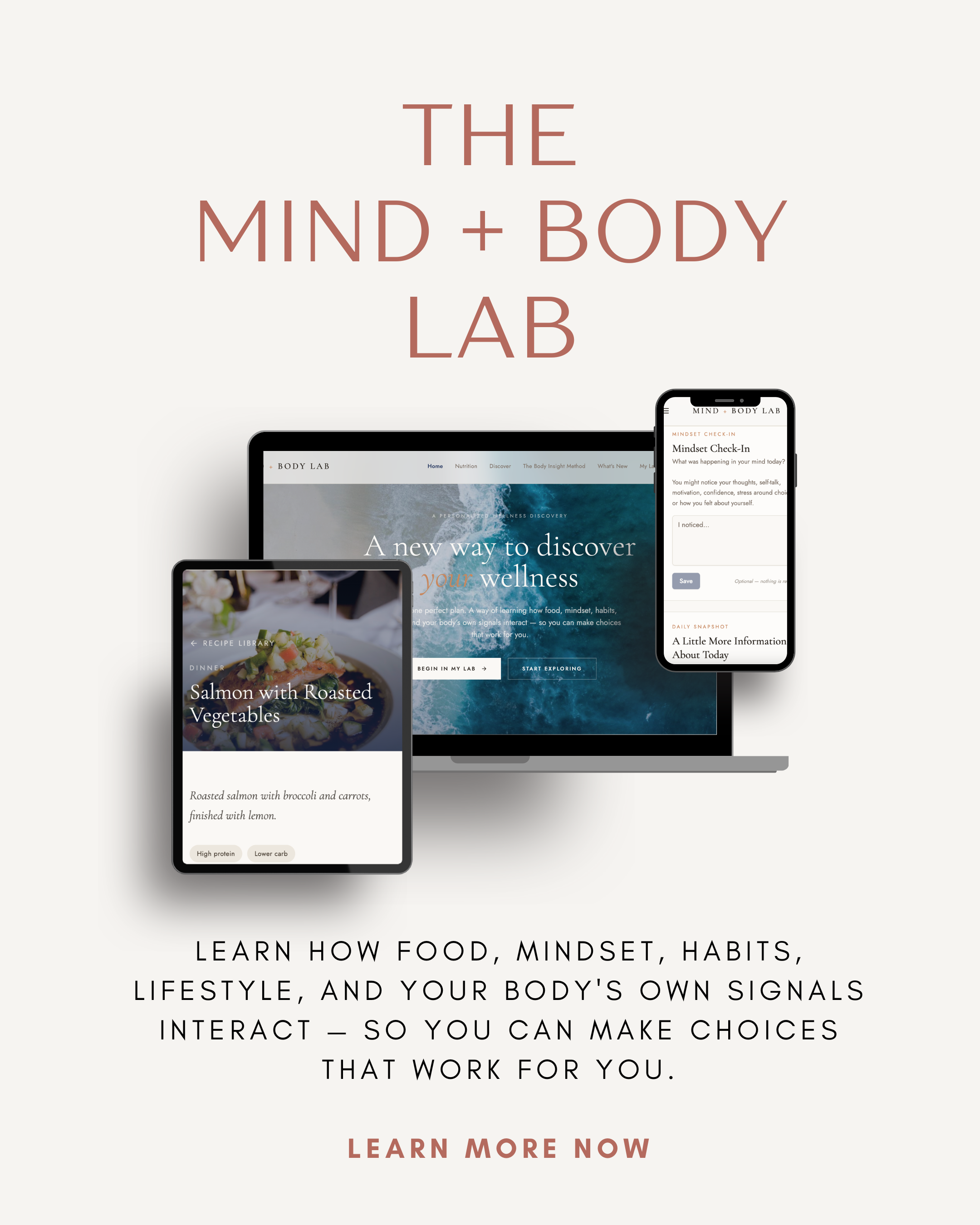
THE MIND + BODY LAB - SAY HELLO TO A NEW WAY TO APPROACH YOUR WELLNESS
A way of learning how food, mindset, habits, lifestyle, and your body's own signals interact — so you can make choices that work for you.
Includes:
Nutrition Pathways (Mediterranean, High Protein, GLP-1 & More - recipes, meal plans & action steps)
Discovery - tools & educations to learn and experiment with. Enjoy topics from mindset (identity, self-talk, limiting beliefs, perfectionism), self-care, habits and motivation to nutrition and eating behaviors.
The Body Insight Method - Learn how to tune into your body & lifestyle to create a wellness plan that works for you.
What’s New (interactive) - A space for our coaches to post weekly topics, reflective thoughts, monthly challenges and more. This is also a place for interaction. You can comment and ask questions to learn more!
My Lab (intuitive + interactive) - Your personal space to practice what you’re learning. Check in, reflect and notice what you’re learning and what’s working (or what isn’t). Let the lab provide helpful tips and pattern recognition to support your wellness & mindset goals.
Get The Mind + Body Lab Today!