


Forget the Rules: 10 Weight Loss Do's & Don'ts That Actually Work
/
If you've tried to lose weight before, you've probably been given a long list of rules. So many of our retreat guests and health coaching clients have come to us with years of experience with diets and weight loss protocols. While plans can be beneficial in some ways, they lack in others. You might have experienced this for yourself so let’s chat about some of the do’s and don’ts that I see as important markers for real, sustainable success.
You might have experienced these:
Eat this.
Don't eat that.
Cut carbs.
Count calories.
Work out harder.
Never skip breakfast.
Never eat after 7 p.m.
The problem isn't that every piece of advice is wrong.
The problem is that many of these rules ignore the most important factor:
You.
Your body.
Your lifestyle.
Your preferences.
Your schedule.
Your goals.
Sustainable weight loss isn't about following someone else's perfect plan. It's about learning what helps you feel and function your best while making progress toward your goals.
That's exactly what I teach through the Body Insight Method.
Instead of chasing another diet, start building awareness. Learn to notice your body's signals, evaluate what's working, and make small adjustments that fit your life.
Here are 10 do's and don'ts that can help you shift from dieting to sustainable wellness.
→ If you're looking for a step-by-step roadmap for wellness & weight loss, we've created The Body Insight Method to help you build a personalized, sustainable approach to wellness that fits your body and your lifestyle. Let’s get into the tips first though. Keep reading below.
DO: Get Clear on Your Goal
Before changing your eating habits or exercise routine, ask yourself why you want to lose weight. I know this might sound cliche but the truth is that it’s a very important piece of the puzzle. Getting clear on why you want to lose weight can help to anchor you to your goal.
Do you want more energy?
Better health?
Greater confidence?
To feel stronger?
To keep up with your kids?
To improve your lab work?
The scale may be the outcome, but understanding why you want to lose weight gives your habits meaning.
DON'T: Let the Scale Define Your Progress
The scale measures one thing:
Your total body weight.
It doesn't tell you:
how much muscle you've gained
how your clothes fit
whether you're sleeping better
if your energy has improved
how strong you've become
how much healthier your habits are
The scale is one data point—not your entire story.
DO: Learn How Much Food Your Body Needs
Some people enjoy calorie tracking.
Others prefer portion guides or intuitive eating.
The method matters less than learning what helps your body feel energized, satisfied, and nourished.
Instead of guessing, build awareness.
If you’re a calorie tracker: use an app such as Cronometer or MyFitnessPal to help guide you (alongside biofeedback markers such as hunger, energy and cravings)
If you’re more of an intuitive eater: learn your hunger and fullness cues and let your body guide you
DON'T: Over-Restrict
Eating less and exercising more isn't always the answer. That’s the old dieter mentality model. Real health and progress comes from fueling properly.
Extreme restriction often leads to:
increased hunger
lower energy
burnout
cravings
difficulty staying consistent
The goal isn't to eat as little as possible.
The goal is to create a way of eating you can sustain.
DO: Build Your Plan Around What You Enjoy
You don't need to force yourself to eat foods you dislike or do workouts you dread. I tell all of our guests and clients to incorporate things they actually like - this journey should actually be enjoyable in addition to a way to reach your wellness goals.
Find nourishing meals you genuinely enjoy.
Discover movement you actually look forward to.
Create routines that fit your schedule.
When healthy habits fit your life, consistency becomes much easier.
DON'T: Follow Someone Else's Formula
We are all unique in our physiology, our psychology, our practical circumstances (lifestyle commitments) and our personal preferences. These all need to be taken into account in order to create a sustainable wellness plan.
There isn't one perfect meal plan.
One perfect macro split.
One perfect workout routine.
One perfect morning routine.
Use education as a guide—not a rulebook. Adaptation is your best friend!
The best plan is the one that works for your body and your life.
DO: Evaluate Regularly
One of the most powerful habits you can build is a weekly check-in.
Ask yourself:
What's working?
What's not?
What made healthy choices easier this week?
What felt difficult?
What can I adjust next week?
Small adjustments create long-term progress.
DON'T: See Setbacks as Failure
Every setback gives you information.
Instead of saying:
"I failed."
Ask:
"What did I learn?"
Maybe Sunday meal prep doesn't fit your schedule.
Maybe your breakfast isn't keeping you full.
Maybe evening snacking happens because lunch wasn't satisfying enough.
Curiosity leads to solutions.
DO: Measure Progress in More Than One Way
The scale is just one unit of measure. It tells one story - total body weight. That’s it. I has no indication of health, your body composition, your strength, endurance or anything else.
The scale isn’t the enemy but it’s helpful to also pay attention to:
Body measurements
Progress photos
Strength gains
Sleep
Hunger
Mood
Energy
Cravings
Lab values
Confidence
These often improve long before the scale reflects your hard work.
DON'T: Compare Your Journey to Anyone Else's
Comparison pulls your attention away from the one body you actually have, the lifestyle you live, and your health. No two people will be the same when it comes to weight loss.
Your physiology is different.
Your schedule is different.
Your stress is different.
Your preferences are different.
Your wellness plan should be different too.
The goal isn't to have someone else's body.
The goal is to understand your own.
Coach's Perspective
One of the biggest mindset shifts I hope people make is moving away from chasing the "perfect" weight loss plan.
Instead, become a student of your own body. Learn to understand yourself.
Notice.
Evaluate.
Adjust.
Repeat.
Those simple steps are what create lasting habits and sustainable results.
Because this is life.
Wellness is about creating balance.
Life is meant to be lived.
This is why I created The Body Mindset Method - to teach you how to listen to your body, understand its cues and create sustainable habits that actually make sense for you and your lifestyle.
Keep Going: Your Next Steps
Want to dive deeper? Here are a few resources to keep the momentum going:
📌 Related Posts
5 Anti-Inflammatory Meals to Support Your Health and Wellness
5 Blood Sugar Management Hacks to Boost Energy and Balance Your Health
✓ Ways To Learn & Grow
Body Insights Method - Learn how to work with your body and lifestyle to create sustainable wellness from the inside out.
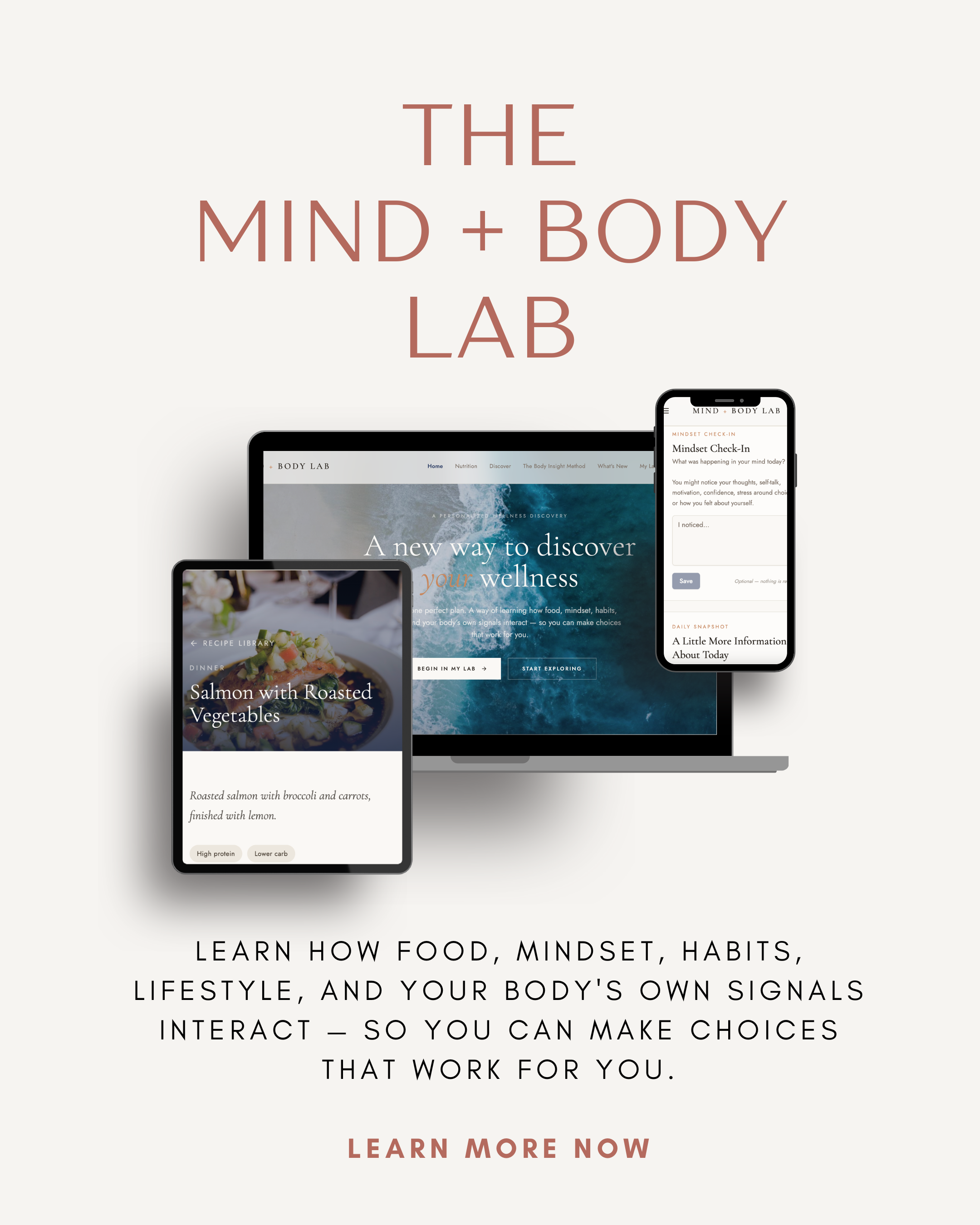
Mind-Body Lab - A guided wellness membership where you'll learn, practice, and grow with monthly education, challenges, and practical wellness tools.
Personalized Wellness Coaching - One-on-one coaching and a personalized plan designed around your body, goals, and lifestyle.
THE MIND + BODY LAB - SAY HELLO TO A NEW WAY TO APPROACH YOUR WELLNESS
A way of learning how food, mindset, habits, lifestyle, and your body's own signals interact — so you can make choices that work for you.
Includes:
Nutrition Pathways (Mediterranean, High Protein, GLP-1 & More - recipes, meal plans & action steps)
Discovery - tools & educations to learn and experiment with. Enjoy topics from mindset (identity, self-talk, limiting beliefs, perfectionism), self-care, habits and motivation to nutrition and eating behaviors.
The Body Insight Method - Learn how to tune into your body & lifestyle to create a wellness plan that works for you.
What’s New (interactive) - A space for our coaches to post weekly topics, reflective thoughts, monthly challenges and more. This is also a place for interaction. You can comment and ask questions to learn more!
My Lab (intuitive + interactive) - Your personal space to practice what you’re learning. Check in, reflect and notice what you’re learning and what’s working (or what isn’t). Let the lab provide helpful tips and pattern recognition to support your wellness & mindset goals.
Get The Mind + Body Lab Today!