




It's Not Willpower: What Your Cravings Might Actually Be Telling You
/
A client asked me a question yesterday that I thought was worth sharing because it gets at something I talk about all the time when we’re working on eating habits and sustainable weight loss. Often times, I draw inspiration from questions that I’m asked or certain scenarios that clients present to me. I figure if they’re asking - some of you are wondering too.
She said, “I always want a cookie. There’s a point almost every day when I want one. Is that just a thought distortion, or does it mean I’m weak-willed?”
My answer was simple: that cookie could mean a lot of different things.
And figuring out what it means is much more useful than deciding that you have no willpower.
This is actually what I teach on a daily basis and what I work with clients on - finding the source of the challenge and then learning how to decode it so you can take the steps to move forward.
The cookie isn't necessarily the problem
When we have a food craving, it’s very easy to jump immediately to the conclusion that we should either give in or resist.
But there’s a step that often gets skipped entirely: Why am I wanting this right now?
That question matters because the same behavior can come from completely different places.
Maybe you’re actually hungry or you might be thirsty. Maybe you need some energy and it could be that you’re just bored. Did something happen that triggered an emotional response? Or could you have simply repeated the same behavior so many times that your brain now expects it.
The cookie may be the behavior you can see, but there can be a lot happening underneath it.
Sometimes your body is asking for something else
There are times when what feels like a food craving is actually your body looking for something it needs. You may be thirsty, for example, but instead of recognizing that signal as thirst, you find yourself reaching for food. Or maybe you haven’t eaten enough and your body is looking for a quick source of energy.
And what’s an easy source of energy? Something familiar. Something you enjoy. Something that is readily available.
Maybe, for you, that has historically been a cookie.
That doesn't mean the cookie is bad. It means it may be worth understanding what your body was actually asking for before you automatically answered the request with food.
Maybe it really is emotional eating
Then there are the moments when something happens and you find yourself wanting food shortly afterward. Questions to ask yourself are:
Did someone say something that bothered you?
Did you have a stressful conversation?
Are you frustrated, overwhelmed, disappointed, or even just tired?
For some people, food has become a coping mechanism over time. It can be a way to soothe, distract, comfort, or simply change how we feel in a particular moment.
If that’s the pattern, telling yourself to “just have more willpower” isn't really addressing the issue. You’re trying to change a behavior without understanding what the behavior has been doing for you. That’s the root of the cause and the understanding that needs to be gained in order to start moving forward.
And sometimes you’re just bored
This one gets overlooked quite a bit.
Consider this - You’re sitting at your desk. You’ve finished what you were working on, or maybe you’re procrastinating something you don’t really want to do. Your mind is looking for stimulation, and food is an incredibly easy way to get it.
Eating gives us something to anticipate, something to taste, something to do, and a quick hit of satisfaction. It’s also socially acceptable, readily available, and something we’ve been conditioned to associate with pleasure.
So if your brain is looking for something interesting to happen, reaching for a cookie can become a very easy answer.
Again, the question isn't necessarily, “How do I stop myself from eating this?”
Maybe the better question is, “What am I actually looking for right now?”
Then there are the patterns we’ve practiced
This is one of the most interesting parts of changing our eating habits because we often don't realize how many of our behaviors have become automatic.
Let's say you get a cookie every afternoon at 2 p.m. At first, you may have made a conscious decision to go get one. Eventually, though, you might not even think about it. Two o'clock comes around, and suddenly you want a cookie. That doesn't necessarily mean your body requires a cookie at 2 p.m.
It may simply mean that you have practiced that behavior enough times that it has become a pattern. And these are the patterns that can be difficult to recognize until you start trying to change them.
This is where awareness becomes so important
The client who asked me this question has actually changed so many of her habits over the last 12 weeks we've worked together. And one of the things I’m noticing now is that she's beginning to see the little details.
She's noticing the thoughts, behaviors, routines, and circumstances that she didn't necessarily recognize before. These seemingly small things can add up over time, and eventually they can become part of the bigger picture of why weight was gained or why certain eating habits developed in the first place.
That's a really important stage of change. Because before you can consistently change a behavior, you have to become aware of it. You have to notice it. And then you have to learn to name what you're experiencing.
Notice → Name
So what do you do when you want the cookie?
Start by noticing.
For the next few days, or even a week, pay attention to when the thought comes up: I need a cookie.
Instead of immediately deciding whether you should eat it or shouldn't eat it, pause for a moment and ask yourself why. What are you feeling right now?
Did something happen that triggered you? Are you sitting at your desk feeling bored? Are you trying to distract yourself from something you don't want to do? Are you thirsty? Have you actually eaten enough today? Do you need a balanced snack?
Start getting curious about the craving rather than judging it. Once you have a better idea of what you actually need, then you can decide what action makes sense. That distinction is important because there really isn't much point in taking random action if you don't understand what the action is supposed to accomplish.
If you discover that you're actually thirsty, for example, your action might be to make sure you're staying adequately hydrated throughout the day. When the craving shows up, you could start by drinking some water and giving yourself a little time to see what happens next.
And if you're still hungry after 20 minutes or so? Maybe you need a snack.
Maybe you eat something balanced.
Or, maybe you have the cookie.
The goal isn't to become someone who never wants a cookie.
The goal is to stop automatically reaching for one without understanding why.
Notice → Name → Understand
You don't need more willpower. You need more information.
This is one of the biggest shifts I try to help people make when we're working on sustainable changes to nutrition and weight.
Instead of asking, “What's wrong with me?” or “Why can't I just control myself?”, start asking, “What is my body, brain, or environment trying to tell me right now?”
Sometimes the answer will be hunger.
Sometimes it will be thirst, energy, boredom, emotion, habit, or something else entirely.
And sometimes, after you've paused and figured it out, you'll realize that you really do want the cookie.
That's okay, too.
Awareness doesn't mean you have to make the “perfect” choice every time. It means you're making a choice with a little more information about yourself.
And over time, those small moments of noticing can teach you more about your own patterns than any rule about what you should or shouldn't eat.
That's not weakness. That's body insight.
Practical Application: Notice → Name → Understand → Take Action
Ways To Learn & Grow
Body Insights Method - Learn how to work with your body and lifestyle to create sustainable wellness from the inside out.
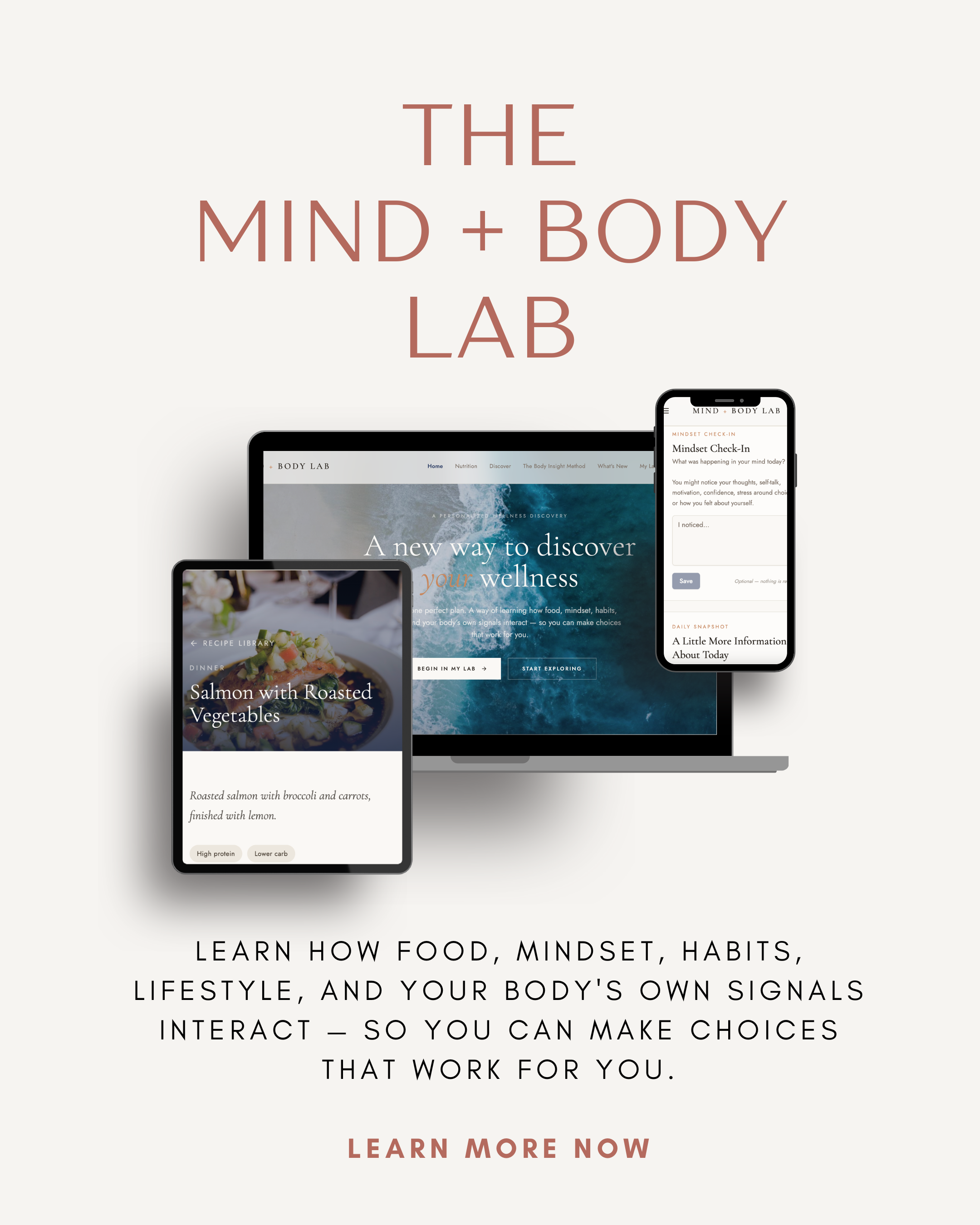
Mind-Body Lab - A guided wellness membership where you'll learn, practice, and grow with monthly education, challenges, and practical wellness tools.
Personalized Wellness Coaching - One-on-one coaching and a personalized plan designed around your body, goals, and lifestyle.
SAY HELLO TO CUSTOMIZED WELLNESS & WEIGHT LOSS WITH THE BODY INSIGHT METHOD
Real, lasting health isn't about following more rules or restrictions—it's about creating balanced wellness that's unique for your body & your lifestyle.
Whether you want to boost energy, improve overall health or lose weight — you’ll learn to notice your body's unique signals, understand what they're telling you, and create a personalized approach to wellness that fits your life.
Includes:
5 Learning Modules, 12 Week Guided Action Plan, Recipes, Meal Plans, Resources & Tracking Tools
3I Framework for Mindset & Goal Setting
Biofeedback & The 4P’s: Customize for Your Body & Your Lifestyle
The Health First Approach to Metabolism
Mindful & Intuitive Eating
The AIM Method: Awareness, Adaptation & Integration
12 Week Guided Action Plan: Build Your Wellness Roadmap
Recipes & Meal Plans: 650+ Recipes & Meal Plans
Tools & Resources - Habit trackers, reflection exercises, and implementation guides.
Learn More Now: The Body Insight Method