




10 Common GLP-1 Questions I Hear As A Health Coach
/
Is this normal? Am I doing this right? What happens next?
The GLP-1 journey can bring a lot of hope, a lot of success and also a lot of questions all at the same time. I’m a health coach specializing in helping people discover sustainable wellness and many of my clients (and also our retreat guests) are taking a GLP-1 medication.
One week you feel great. The next week your appetite changes. Maybe your weight loss slows down, you're worried about losing muscle, or you're wondering if you're eating enough.
These are the conversations I have with coaching clients every single week.
One of the things I've noticed is that many people begin their GLP-1 journey feeling like they're figuring it out alone. They scroll social media, compare their progress to someone else's, or wonder if what they're experiencing is "normal."
The truth is, there isn't one normal.
Different medications, different dosages, different health histories, different lifestyles, and different bodies all influence how someone responds.
That's why I always encourage my clients to become students of their own body instead of comparing themselves to everyone else.
Below are some of the most common questions I hear during coaching sessions and the perspective I often share with clients as they learn to build healthy habits that support both their medication and their long-term health.
→ If you're looking for a step-by-step roadmap for wellness & weight loss, we've created The Body Insight Method to help you build a personalized, sustainable approach to wellness that fits your body and your lifestyle.
1. My Weight Has Stalled. Is That Normal?
Yes—it absolutely can be.
Many people assume they'll start a GLP-1 medication and lose weight consistently every single week. While that certainly happens for some people, it's not everyone's experience.
Sometimes weight loss slows because your body is adapting.
Your dosage simply might not be the right fit yet (which can be adjusted over time).
Sometimes another medication may ultimately be a better option.
I've worked with clients who needed to gradually increase their dosage before seeing steady progress, and I've also coached clients who experienced better results after working with their healthcare provider to transition to a different medication.
But before assuming the medication isn't working, I always encourage clients to zoom out.
Together we evaluate:
Protein intake
Hydration
Strength training
Daily movement
Fiber intake
Sleep
Stress
Overall consistency
The medication is one piece of the puzzle but your daily habits still matter.
If you've experienced several months of little or no progress despite consistently supporting your body with healthy habits, that's an excellent time to have a conversation with your healthcare provider.
Coach's Perspective
Rather than asking, "Why isn't this working?" It might be helpful to ask yourself:
What information is my body giving me right now? What are my daily habits like? Am I giving this 100% on all levels?
That shift alone often changes everything.
2. I'm Worried About Losing Muscle. What Should I Do?
If there's one thing you've probably heard me say before (if you coach with me or if you read my blot posts), it's this:
Protein. Protein. Protein.
Protecting lean muscle mass is one of the most important priorities while taking a GLP-1 medication.
I generally encourage clients to build meals around quality protein sources while also following a consistent strength training program.
For many people, aiming for roughly 20-30 grams of protein per meal is a great starting point, although individual needs vary based on body size, activity level, age, and goals.
Strength training is equally important.
Lifting weights or performing resistance exercises several times per week gives your body a reason to hold onto muscle while you're losing weight.
I also encourage clients to look beyond the scale.
Pay attention to:
Body composition measurements
Strength improvements
Progress photos
Body measurements
How your clothes fit
Energy levels
The scale tells you one number. Your body tells you so much more.
Coach's Perspective
The goal isn't simply to lose weight.
The goal is to lose weight sustainably (and even manage blood sugar) and that take supporting strength, mobility, and long-term health.
3. Am I Eating Enough?
Reduced appetite is one of the reasons GLP-1 medications can be so effective. Unfortunately, eating significantly less doesn't automatically mean you're nourishing your body well.
How would you know if you’re eating enough? Tuning into things like energy, mood, sleep and even strength and endurance can be great ways to understand if you’re getting enough nutrition.
One of the biggest shifts I encourage is focusing less on eating less and more on making the food you do eat count.
When appetite is low, prioritize:
Protein first
Colorful fruits and vegetables
Fiber-rich foods
Healthy fats
Hydration
Many of my clients do well with balanced mini meals rather than forcing themselves to eat large portions.
Small meals can absolutely meet your nutrition needs when they're built intentionally. Even 200-300 calories at a time 4-6x daily (depending on your calorie needs) can help to keep meals manageable for reduced hunger and still ensure you’re getting enough food.
Coach's Perspective
Your goal isn't to eat as little as possible.
Your goal is to nourish your body with the nutrients it needs. Restriction does not equal health - ensuring you get enough protein, healthy fats, healthy carbs, fruit & vegetables, colorful foods and hydration is essential.
It might also help to establish a baseline or minimum calorie count for each day and aim to meet that.
Will I Have To Stay On A GLP-1 Forever?
This is probably one of the most common questions I receive.
The honest answer is...
It depends.
For some people, long-term treatment makes sense.
Others may eventually transition to a lower maintenance dose.
Some people work with their healthcare provider to gradually discontinue the medication.
There isn't one right answer. I’ve honestly seen all of these scenarios with my clients so it really depends on the person.
Your health history, goals, medical conditions, and overall response to treatment all play a role in that decision.
This is always a conversation to have with your prescribing healthcare provider.
Coach's Perspective
Whether you stay on medication for months or years, I recommend using this time to build habits they'll be able to rely on for life.
The healthier your foundation becomes, the more options you'll have moving forward.
How Can I Minimize Side Effects?
Side effects vary quite a bit from person to person.
Some people experience nausea.
Others struggle with constipation or digestive changes.
Many side effects improve over time as your body adjusts.
In addition to staying in close communication with your healthcare provider, I always ask clients to focus on the basics that often make a difference:
Stay well hydrated.
Prioritize protein.
Include fiber gradually.
Continue moving your body.
Avoid waiting until you're overly hungry before eating.
Eat slowly and pay attention to fullness cues.
If side effects become severe or persistent, your healthcare provider may recommend adjusting your dosage or exploring another medication.
Coach's Perspective
Your body is constantly giving you feedback.
Rather than ignoring it, become curious about what it's telling you. Often, you’ll find the answers in the signs and signals it’s sending.
How Do I Know If I'm Actually Making Progress?
Progress isn't measured by the scale alone.
Some of the biggest improvements happen long before dramatic weight loss. Things like managed hunger, less food noise, balanced blood sugar and better energy are some of the non-scale victories that show up on a GLP-1 depending on the person.
I encourage clients to monitor multiple forms of progress, including:
Body measurements
Body composition
Strength gains
Energy
Sleep
Hunger
Mood
Cravings
Mobility
Confidence
The more data you gather, the more complete your picture becomes.
Coach's Perspective
One number never tells the whole story. Your body provides far more information than the scale ever will—if you're willing to notice it.
Use as many metrics as possible to track your progress from a big picture view.
I only have about 10 pounds to lose. Is a GLP-1 still worth considering?
This is a question I hear more often than you might think, especially with so many social media ads promoting GLP-1 medications as a quick way to lose those "last 10 pounds." In fact, I just recently saw an ad on TikTok for a quick 10 pound loss for summer and it promoted a GLP-1.
The answer isn't a simple yes or no. It's a conversation that's best had with your healthcare provider, taking into account your health history, goals, and the potential benefits and risks of treatment.
What I do encourage people to think about is the long-term plan.
Losing 10 pounds and maintaining that 10-pound loss are two very different things.
GLP-1 medications can absolutely help reduce appetite and support weight loss, but they don't automatically build the habits that make weight maintenance sustainable. Whether your goal is to lose 10 pounds or 100 pounds, the same question still applies:
What will support your health after the weight is gone?
That's why, throughout the coaching process, I urge clients to focus on the habits they'll want to carry with them long after the medication has done its job:
Eating enough protein
Prioritizing strength training
Learning appropriate portion sizes
Understanding hunger and fullness cues
Staying hydrated
Building routines that fit real life
Some people remain on a GLP-1 long term. Others work with their healthcare provider to gradually taper off or transition to a maintenance plan. There's no one-size-fits-all approach, and the right decision depends on your individual circumstances.
→ What I don't encourage is thinking of a GLP-1 as a temporary shortcut.
If your only goal is to lose 10 pounds as quickly as possible without building the habits to support that weight afterward, there's a much greater chance that maintaining those results will be difficult once the medication changes or stops (if it does).
Coach's Perspective
Whether your goal is 10 pounds or 100 pounds, it can be helpful to think beyond the number on the scale.
Ask yourself:
What habits do I want to have a year from now?
How do I want to feel every day?
What kind of lifestyle could I actually see myself maintaining?
The medication can be one tool in the process, but lasting success almost always comes back to the same foundation: learning how your body responds, building supportive habits, and creating a wellness approach you can sustain for the long term.
How do I know which GLP-1 is right for me?
This is another question that comes up frequently in coaching, especially with so many medications available today.
The first thing I recommend is doing a little homework before your appointment. Learn about the different medications, understand how they work, and think about what you hope to accomplish.
Then have an honest conversation with your healthcare provider. Ask questions and get informed!
Choosing a medication isn't simply about which one promises the most weight loss. It's also about considering your health history, medical conditions, side effects, insurance coverage, long-term goals, and how the medication fits into your lifestyle.
Not every medication is the right fit for every person.
In coaching, I've seen clients do incredibly well on one medication while someone else experienced better results after switching to another. I've also seen people need dosage adjustments before they began seeing meaningful progress.
Finding the right medication sometimes takes patience—and that's okay.
Practical next steps
Think about your short- and long-term goals.
Discuss your health history with your healthcare provider.
Ask about expected results, side effects, and maintenance plans.
Continue building healthy habits regardless of which medication you choose.
Coach's Perspective
The "best" GLP-1 isn't necessarily the one that leads to the fastest weight loss. It's the one that safely supports your health while giving you the opportunity to build habits you can sustain long term.
I've plateaued after several months. What now?
Plateaus are one of the most common concerns I hear from coaching clients.
Many people expect weight loss to continue at the same pace indefinitely, but that's rarely how the body works — even on a GLP-1.
As your body changes, your calorie needs change. Your metabolism adapts. Your routines become familiar. Weight loss naturally slows for many people over time.
A plateau doesn't automatically mean the medication has stopped working. Instead, it's often an opportunity to reassess what's happening.
Are you consistently eating enough protein?
Have your portions gradually increased?
Are you strength training?
Are you moving enough throughout the day?
How are your sleep, stress, and recovery?
Sometimes the next step is simply tightening up a few habits. Other times, your healthcare provider may recommend adjusting your dosage or discussing a different medication.
The important thing is not to assume you've failed. What you can do as a first step:
Reassess your protein intake.
Continue prioritizing strength training.
Look at your daily movement—not just structured workouts.
Review your sleep, stress, hydration, and recovery.
Talk with your healthcare provider if your plateau has been persistent despite consistent habits.
Coach's Perspective
One thing I remind clients often is this: A plateau is information—not failure.
It's simply your body's way of telling you it's time to evaluate, adjust, and keep moving forward.
What if I stop taking my medication or lose insurance coverage?
This is becoming an increasingly common concern.
Some people decide they'd like to stop taking a GLP-1. Others discover their insurance no longer covers the medication and some insurance companies will only cover certain medications. Any of those situations can feel overwhelming.
The good news is that there are options.
If you're thinking about stopping your medication—or you're forced to because of insurance—it's important to involve your healthcare provider. In many cases, they may recommend a gradual taper rather than stopping abruptly.
From a coaching perspective, this is exactly why harp on building healthy habits from day one.
Protein.
Strength training.
Balanced meals.
Hydration.
Movement.
Learning your hunger and fullness cues.
These habits become your foundation regardless of what happens with the medication.
The stronger your habits become, the smoother the transition is likely to feel. Your next steps could include:
Speak with your healthcare provider before making changes to your medication.
Continue prioritizing protein and strength training.
Maintain your daily wellness routines.
Monitor your hunger, energy, cravings, and progress as your body adjusts.
Give yourself time—your body may need an adjustment period.
Coach's Perspective
One of my biggest goals as a coach is to help people become less dependent on rules and more connected to their own bodies.
Whether you're taking a GLP-1, transitioning off one, or simply working toward better health, the skills you develop along the way are what create lasting success.
That's why I like to help clients to view the medication as one tool, while also learning how their body responds, what habits help them feel their best, and how to build a wellness plan they can sustain for years to come.
My Final Thoughts
One of the biggest lessons I've learned after coaching people through GLP-1 medications is that the medication is only one piece of the puzzle. The people who tend to have the greatest long-term success aren't necessarily the ones who lose weight the fastest.
They're the ones who learn their body. They notice what helps them feel energized. They recognize when they're truly hungry. They build meals that support muscle and satiety.
They understand how stress, sleep, hydration, movement, and nutrition all work together. They evaluate what's working, adjust what isn't, and continue moving forward.
Whether you're just beginning your GLP-1 journey or you've been on medication for months, I encourage you to stay curious about your body instead of chasing perfection or simply a number on the scale.
Every observation gives you more information.mEvery adjustment teaches you something.
Lasting wellness isn't about following someone else's plan. It's about learning what works for your body so you can build a way of eating and living that continues to support you—on medication or off.
I created The Body Insight Method to help you tune into your own body, understand what works for you and formulate the habits that actually support lasting wellness for your body and your lifestyle. You can learn more HERE.
More GLP-1 Resources
Ways To Learn & Grow
Body Insights Method - Learn how to work with your body and lifestyle to create sustainable wellness from the inside out.
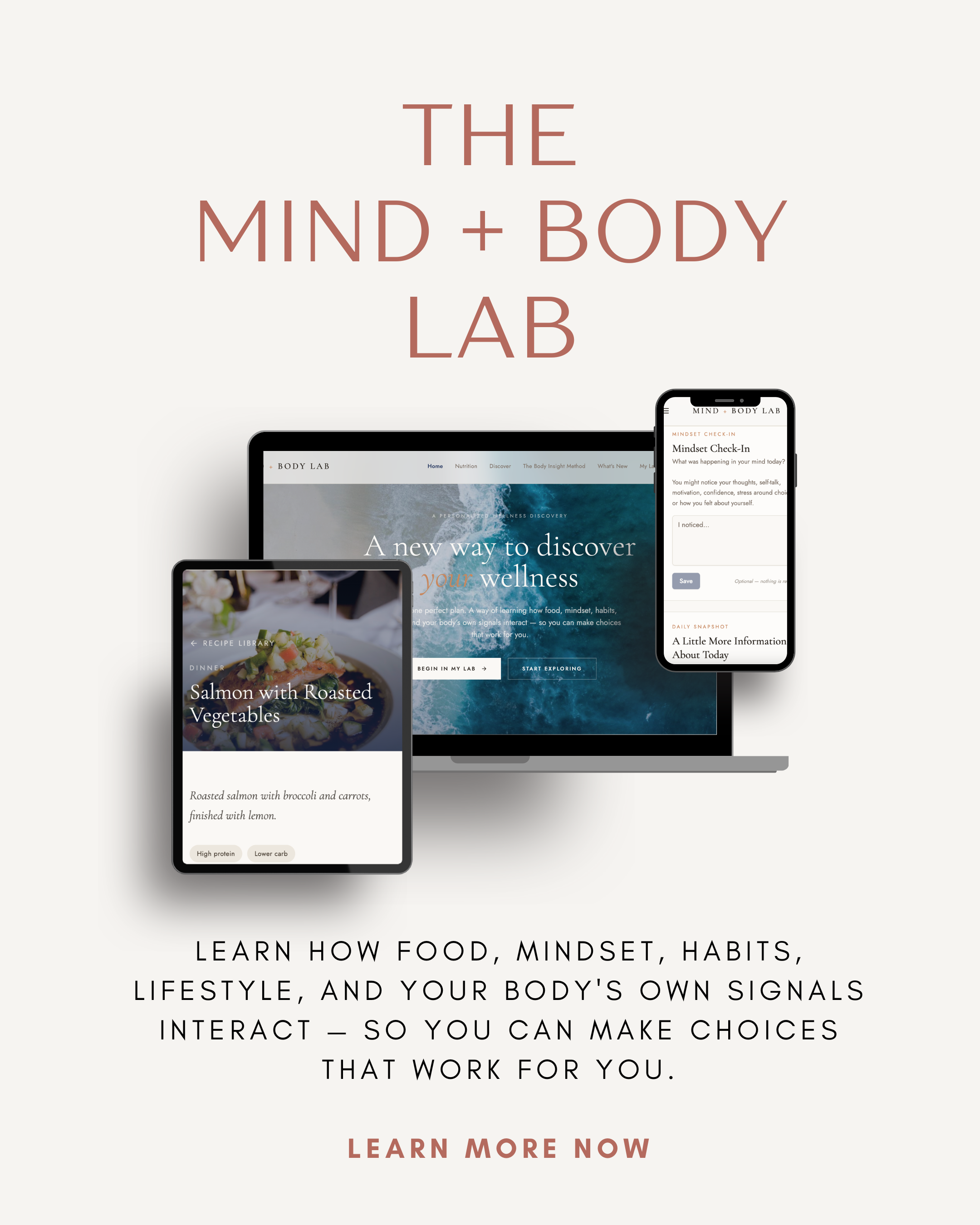
Mind-Body Lab - A guided wellness membership where you'll learn, practice, and grow with monthly education, challenges, and practical wellness tools.
Personalized Wellness Coaching - One-on-one coaching and a personalized plan designed around your body, goals, and lifestyle.
THE MIND + BODY LAB - SAY HELLO TO A NEW WAY TO APPROACH YOUR WELLNESS
A way of learning how food, mindset, habits, lifestyle, and your body's own signals interact — so you can make choices that work for you.
Includes:
Nutrition Pathways (Mediterranean, High Protein, GLP-1 & More - recipes, meal plans & action steps)
Discovery - tools & educations to learn and experiment with. Enjoy topics from mindset (identity, self-talk, limiting beliefs, perfectionism), self-care, habits and motivation to nutrition and eating behaviors.
The Body Insight Method - Learn how to tune into your body & lifestyle to create a wellness plan that works for you.
What’s New (interactive) - A space for our coaches to post weekly topics, reflective thoughts, monthly challenges and more. This is also a place for interaction. You can comment and ask questions to learn more!
My Lab (intuitive + interactive) - Your personal space to practice what you’re learning. Check in, reflect and notice what you’re learning and what’s working (or what isn’t). Let the lab provide helpful tips and pattern recognition to support your wellness & mindset goals.
Get The Mind + Body Lab Today!