




Emotional Eating: Why It Happens & How To Take Back Control
/
Have you ever found yourself eating an entire pizza after a stressful day at work? Or reaching for ice cream after a weigh-in that didn’t go the way you hoped? Maybe you had a really healthy meal planned but something triggered you and you ended up doing the opposite?
You’re not alone.
This is something many people experience—and it has a name: emotional eating.
At its core, emotional eating is when food is used in response to feelings rather than physical hunger. It’s used as a coping mechanism. It’s a great source of dopamine - that feel good hormone that helps you instantly have a boost.
And while it can feel comforting in the moment, it often doesn’t actually resolve what you’re feeling underneath.
Instead, you may end up feeling more frustrated, disconnected, or stuck in the same cycle again later.
To help you work through emotional eating, let’s get into what it is, what causes it and the best part - the strategies.
Why We Turn to Food Emotionally
In the fitness and diet industry, there’s this touted phrase that food is fuel. Food is not just fuel though—it’s also emotional.
From a brain-based perspective, eating is one of the fastest ways to activate the brain’s reward system. Highly palatable foods (sugar, fat, salt combinations) stimulate dopamine, which is the “feel good” neurotransmitter associated with pleasure and reward.
So when you’re stressed, overwhelmed, lonely, or even bored, your brain quickly learns:
“This helps me feel better… fast.”
Over time, this creates a learned association between emotions and eating.
This is how “comfort foods” are formed. How often have you said, “X is my comfort food?”
It’s not random—it’s conditioning.
Your brain starts linking certain emotional states with certain foods:
Stress → sweets
Sadness → carbs
Exhaustion → salty snacks
Even happiness → celebratory eating & drinking
And eventually, this becomes automatic.
Not because you lack willpower—but because your brain has built a shortcut.
The Emotional Eating Loop
Emotional eating often follows a predictable cycle:
Trigger: stress, emotion, or internal discomfort
Thought: “I need something to feel better”
Behavior: eating (even without physical hunger)
Short-term relief: temporary dopamine hit
Aftermath: guilt, discomfort, or frustration
Then the cycle repeats.
The key insight here is this:
Emotional eating isn’t a food problem—it’s a coping pattern.
And like all patterns, it can be changed.
The Good News: This Is a Learned Behavior (Which Means It Can Be Unlearned)
Just as your brain learned to connect emotions with food, it can also learn new ways to respond.
This doesn’t mean eliminating emotional eating overnight or expecting perfection.
It means building awareness + alternative responses so food is no longer your only coping tool.
The goal is not restriction—it’s choice.
Step 1: Notice When and Why It’s Happening
Before anything can change, awareness has to come first.
Start by gently noticing:
What was happening right before I ate?
What emotion was I feeling?
Was I physically hungry or emotionally activated?
What was I actually needing in that moment?
There’s no judgment here—just curiosity.
Even simple awareness starts to interrupt the automatic pattern.
Step 2: Pause Before You React
Once you notice the urge to eat emotionally, the next step is creating space between the trigger and the behavior.
This is where change begins.
Instead of immediately reaching for food, pause and ask:
“What do I actually need right now?”
That pause—even if it’s only 10–20 seconds—is powerful. It shifts you from automatic response into conscious choice.
Step 3: Practical Strategies for Emotional Eating
Once you’ve built awareness, the next step is experimenting with new responses.
Not all strategies will work every time—and that’s okay. The goal is to build flexibility, not rules.
My recommendation is to pick a strategy and get clear on how you’ll use it. Being prepared when you face emotional eating is half the battle.
Here are a few tools to try:
Delay
Set a timer for 15–20 minutes before eating.
You’re not saying “no”—you’re saying “not yet.”
Often, the emotional intensity decreases with time, and you can reassess whether you’re truly hungry.Distract
Shift your attention somewhere else for a short period of time.
This might include:Going for a walk
Listening to music
Doing a quick task
Calling a friend
Engaging in a hobby
You’re not avoiding emotions—you’re giving them space to settle before reacting.
Substitute
Sometimes the urge to eat is real—but it doesn’t have to come from highly processed or emotionally charged foods.
Try having supportive options available:
Greek yogurt with berries
Fruit + nut butter
Protein snack plate
Herbal tea + something warm and grounding
This keeps the comfort, without the emotional crash afterward.
Drink Instead of Eat
Hydration plays a bigger role than most people realize.
Before eating, try:
Sparkling water
Herbal tea
A glass of water with electrolytes
Thirst and emotional discomfort can sometimes feel very similar in the body.
Work Through the Emotion
This is the most overlooked step—and often the most powerful.
Instead of suppressing what you feel, allow space for it:
Journal what’s coming up
Do a short meditation or breathing exercise
Name the emotion without judgment
Ask: “What is this feeling trying to tell me?”
Emotions are not problems to fix—they are signals to understand.
When you begin processing emotions instead of immediately numbing them, the need to use food as comfort naturally decreases over time.
Repetition Rewires The Brain (And That Can Take Time)
One of the most important things to understand is that emotional eating is not something you “fix” overnight.
You’re literally rewiring a learned response pattern in the brain.
That takes repetition, time, practice and grace with yourself along the way.
Some days you’ll pause. Some days you won’t. Some days food will still be the coping tool (and that’s ok).
That’s part of the process—not failure. In fact, most of us learn from the challenging moments. We don’t often learn as much when things are going really well. Embrace the tough moments and put your tools into practice.
What matters is that over time, you start creating more space between emotion and action.
That space is where change happens and long-term habits are built.
Coaching Notes
So often, we blame ourselves. Why can’t I just stop this habit? Emotional eating is not about lack of control—it’s about learned patterns, nervous system responses, and emotional regulation skills.
And the goal is not to never eat emotionally again.
The goal is to:
Recognize what’s happening
Understand what you’re actually needing
And build more ways to respond
Food can still be comfort and you can actually cope with food but you can’t do it all of the time. It can’t be the “go-to” mechanism for relief.
What Comes Next
Choose a tool that you think will work for you. Make a mental note and incorporate it the next time you go to food to soothe yourself.
Practice that tool for two weeks - a month. Reflect on how it works for you. If it does, keep using that same tool! If not, shelve it and try a different strategy. There is no failure - just learning.
More Resources:
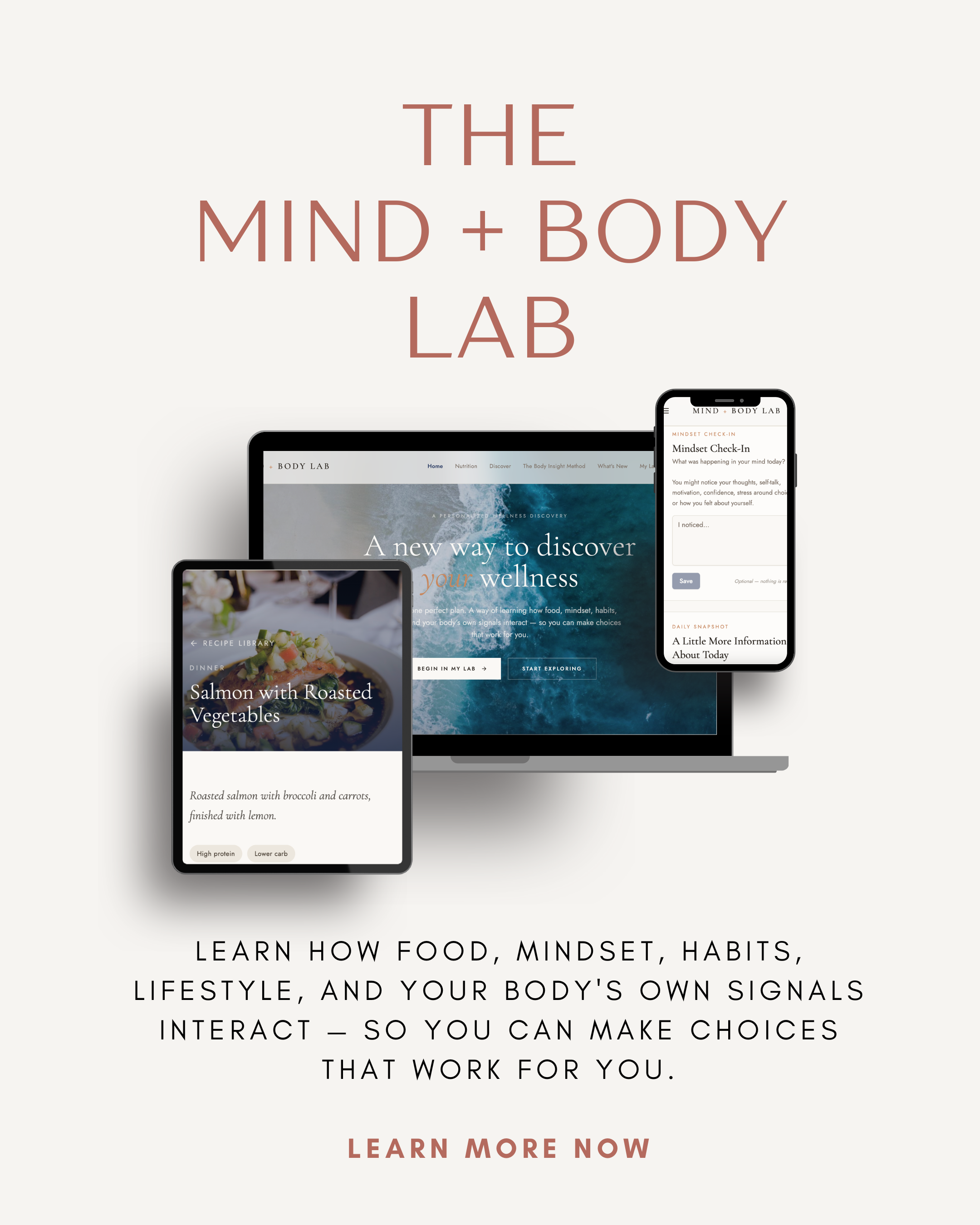
THE MIND + BODY LAB - SAY HELLO TO A NEW WAY TO APPROACH YOUR WELLNESS
A way of learning how food, mindset, habits, lifestyle, and your body's own signals interact — so you can make choices that work for you.
Includes:
Nutrition Pathways (Mediterranean, High Protein, GLP-1 & More - recipes, meal plans & action steps)
Discovery - tools & educations to learn and experiment with. Enjoy topics from mindset (identity, self-talk, limiting beliefs, perfectionism), self-care, habits and motivation to nutrition and eating behaviors.
The Body Insight Method - Learn how to tune into your body & lifestyle to create a wellness plan that works for you.
What’s New (interactive) - A space for our coaches to post weekly topics, reflective thoughts, monthly challenges and more. This is also a place for interaction. You can comment and ask questions to learn more!
My Lab (intuitive + interactive) - Your personal space to practice what you’re learning. Check in, reflect and notice what you’re learning and what’s working (or what isn’t). Let the lab provide helpful tips and pattern recognition to support your wellness & mindset goals.
Get The Mind + Body Lab Today!