




How Stress Can Affect Hunger and Eating Habits
/
Have you ever noticed that your hunger seems different when you're stressed?
Maybe you're suddenly thinking about food more often. Maybe you find yourself craving something sweet, salty, crunchy or chocolatey. Maybe your usual eating routine goes completely out the window. Or maybe stress has the opposite effect and you don't feel hungry at all.
Stress can affect everyone differently, but it can have a real impact on hunger, cravings and eating patterns.
Understanding the connection between stress and hunger can help you recognize what's happening without judging yourself for it. And once you recognize the pattern, you can start experimenting with different ways to respond.
How Stress Can Affect Hunger
When you're under stress, your body responds by releasing hormones and activating systems designed to help you deal with a perceived threat or challenge.
One of the hormones involved is cortisol. Changes in cortisol and other stress-related signals can influence appetite, food cravings and the way you experience hunger.
This is one reason you may notice that your eating feels different during particularly stressful periods.
But there's another piece of the puzzle, too. Food can become a coping mechanism for stress.
Eating is readily available, familiar and socially acceptable. Certain foods can also provide a pleasurable experience that temporarily shifts how you feel.
So when you're stressed, reaching for something to eat can become an automatic response—not necessarily because your body needs more fuel, but because your brain has learned that food can provide a moment of comfort, pleasure or relief.
That doesn't mean stress eating is a failure or that you need to eliminate it completely. It means there's an opportunity to become more aware of what's happening.
→ Want more support? Explore Mind + Body Lab.
What You Might Notice When You're Stressed
One of the most useful things you can do is simply pay attention to how stress affects you.
Here are a few patterns you might notice.
Increased hunger
You may feel hungrier than usual or find yourself thinking about food more frequently.
Sometimes this can be related to the body's response to stress. It can also happen because stress disrupts your normal routines—you may be sleeping differently, eating at different times, skipping meals or simply having a harder time tuning into your body's signals.
Increased cravings
Stress can also make certain foods particularly appealing.
Maybe you want something sweet, salty, crunchy, or even chocolatey. You might find yourself wanting a very specific food even though you weren't thinking about it earlier in the day.
Cravings aren't inherently bad. They're simply information. The important thing is to become curious about what may be driving them.
Disrupted eating patterns
Sometimes stress doesn't necessarily make you eat more. It changes how you eat.
You might skip breakfast because you're rushing. Forget to eat lunch because you're busy. Find yourself grazing throughout the afternoon. Eat much later than usual. Or suddenly realize that your normal eating routine has completely disappeared.
Your usual hunger cues and eating patterns can shift when your normal routine is disrupted.
Eating for comfort or relief
Sometimes what you're looking for isn't really food. You're looking for a break. You might be looking for comfort, or even a distraction.
Food happens to be an easy way to get there. And because eating can provide a pleasurable experience, it can become a very familiar response to stress.
The goal isn't to criticize yourself for eating. It's to notice it.
Ask Yourself: Am I Hungry or Am I Stressed?
This is one of my favorite questions to use when I'm trying to understand an eating pattern:
What do I actually need right now?
If you're hungry, eat.
But if you've just received a stressful email, had a difficult conversation, gotten overwhelmed at work or experienced some other trigger, take a moment to check in.
Am I physically hungry, or have I been triggered?
And if you've been triggered, ask:
Do I actually need food right now, or is there another way I could respond to what I'm feeling?
You don't have to answer the question perfectly. The pause itself is useful. It creates a little space between the trigger and your response—and that gives you an opportunity to make a choice rather than automatically following the same pattern.
Have Easy Options Available
One of the simplest strategies for managing hunger—whether you're stressed or not—is to make nourishing food easy to access.
Keep healthy snacks available.
Have a few simple meals you can make quickly.
Keep foods you enjoy and that help you feel satisfied on hand.
This is especially helpful when you're busy or stressed because you don't have to make as many decisions in the moment.
Maybe you have fruit and Greek yogurt ready to grab. A handful of nuts. Cut-up vegetables and hummus. A hard-boiled egg. A simple, balanced meal that you can heat up.
The specific foods aren't necessarily the point. The point is reducing friction.
When you're stressed, tired or busy, the easiest option often wins. So make the option that supports you an easy one.
Try a Different Tool
If you've paused and realized that you're not actually hungry, you have another opportunity:
What else could help me right now?
You might try:
Listening to music
Taking a few slow, deep breaths
Calling a friend
Going for a short walk
Taking a shower
Stepping outside
Starting a small project
Reading
Journaling
Meditating
Doing something that makes you laugh
You don't need to find the perfect stress-relief strategy.
You're simply giving yourself another option.
And sometimes that option is enough to change what happens next.
Shift Your Focus
Distraction can be a useful tool when you're caught in a stress-eating loop.
This doesn't mean you have to ignore your feelings or keep yourself constantly busy so you don't have to deal with them.
It can be as simple as shifting your focus.
If you've been sitting at your desk thinking about the stressful situation for the last 30 minutes, get up and do something completely different.
Put on music.
Walk into another room.
Start folding laundry.
Work on a project.
Call someone.
Go outside.
The goal is to interrupt the pattern and give your brain something else to focus on. Sometimes a small shift is enough to create some distance from the immediate urge.
Change Your Environment
Sometimes changing your environment can be surprisingly powerful.
If you're stressed at your desk, get out of your office.
If you're standing in the kitchen looking for something to eat, go somewhere else.
If you've been sitting in the same room stewing over something, move to a different room or go outside.
A change in environment can help interrupt an automatic pattern because you're no longer surrounded by the same cues and circumstances that were reinforcing it.
You don't have to make a major change. Sometimes simply getting up and going somewhere else is enough to give yourself a reset.
Drink Something
Sometimes what you need in the moment is simply a change in sensation or something to do with your hands.
Try drinking water, sparkling water, tea or another beverage you enjoy. This isn't about using water to suppress hunger or replacing food when you're actually hungry.
If you're hungry, eat. But if you're stressed and looking for something to do in that moment, having a drink can be another simple option while you check in with yourself.
Don't Forget About the Stress Itself
Managing stress-related eating isn't only about what you do when you're standing in front of the pantry.
It's also about looking at the bigger picture.
Where is your stress coming from?
Is it work? Your schedule? Relationships? Not enough downtime? Taking on too much? Not sleeping enough? Not having enough time for yourself?
Once you start identifying the sources of your stress, you can start looking for ways to address them. And this doesn't have to mean completely overhauling your life. In fact, I think that's one of the biggest mistakes we make when we're trying to manage stress. We think we need to do everything but even a small step forward helps:
Meditate for 30 minutes.
Exercise every day.
Sleep eight hours.
Meal prep for the entire week.
Take up yoga.
Journal.
Go to therapy.
Eliminate every source of stress.
That's a lot.
Instead, ask yourself:
What's one small thing I can do today that might help?
Give Yourself Room to Experiment
There's no single stress-management tool that works for everyone. And even the tools that work for you won't necessarily work every time.
Think of this as an experiment. Here’s the step by step instructions to follow:
Notice the pattern.
Pause.
Ask yourself what you need.
Try a different response.
See what happens.
Maybe going for a walk works really well for you.
Maybe calling a friend works better.
Maybe changing your environment is enough.
Maybe you discover that you're actually hungry and the best thing you can do is sit down and eat a satisfying meal.
The goal isn't to find a way to never stress eat again. The goal is to understand yourself better so that you can choose a response that works for you, your body and how you want to feel and function.
Stress, Hunger and Your Overall Well-Being
Stress is a normal part of life. You aren't going to eliminate it completely, and you don't need to. What matters is learning how stress tends to show up for you and developing ways to support yourself when it does. The more you notice these patterns, the more choices you have.
So start small. Pay attention to what stress does to your hunger. Make nourishing foods easy to access. Pause when you notice a craving or urge to eat and ask yourself what you actually need. Try another tool when appropriate.
Wellness isn't about responding perfectly to stress. It's about learning how to support yourself through it.
Keep Going: Your Next Steps
Want to dive deeper? Here are a few resources to keep the momentum going:
📌 Related Posts
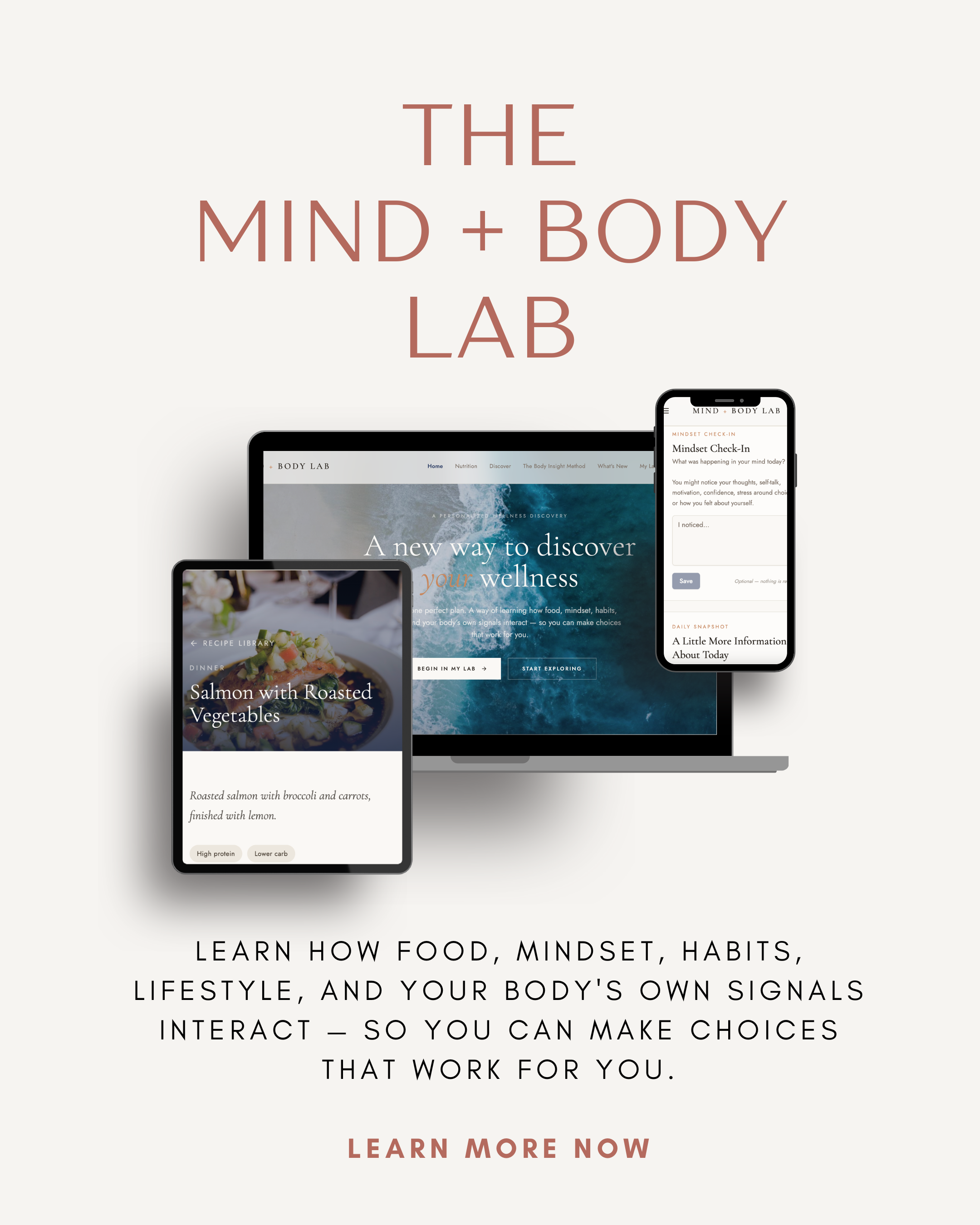
THE MIND + BODY LAB - SAY HELLO TO A NEW WAY TO APPROACH YOUR WELLNESS
A way of learning how food, mindset, habits, lifestyle, and your body's own signals interact — so you can make choices that work for you.
Includes:
Nutrition Pathways (Mediterranean, High Protein, GLP-1 & More - recipes, meal plans & action steps)
Discovery - tools & educations to learn and experiment with. Enjoy topics from mindset (identity, self-talk, limiting beliefs, perfectionism), self-care, habits and motivation to nutrition and eating behaviors.
The Body Insight Method - Learn how to tune into your body & lifestyle to create a wellness plan that works for you.
What’s New (interactive) - A space for our coaches to post weekly topics, reflective thoughts, monthly challenges and more. This is also a place for interaction. You can comment and ask questions to learn more!
My Lab (intuitive + interactive) - Your personal space to practice what you’re learning. Check in, reflect and notice what you’re learning and what’s working (or what isn’t). Let the lab provide helpful tips and pattern recognition to support your wellness & mindset goals.
Get The Mind + Body Lab Today!