




How to Bridge the Gap Between Physical Fitness and Psychological Health
/
For decades, the worlds of physical fitness and mental health existed in separate silos. You visited your doctor for your body and your therapist for your mind, rarely acknowledging that the two were deeply, inseparably connected. That rigid division is finally breaking down, and science is leading the charge.
Research now confirms what ancient philosophers long suspected: the body and the mind are not two distinct systems running parallel to each other. They are one integrated whole, constantly in conversation. Your morning run shapes your mood for the rest of the day. Your chronic anxiety quietly tightens your muscles and raises your blood pressure. Your sleep quality influences everything from your emotional resilience to your immune response.
Yet despite this growing awareness, many people still approach their health in fragments, focusing on losing weight without addressing the stress that triggers emotional eating, or managing depression without considering how sedentary habits intensify it. The result is a cycle of frustration, partial progress, and eventual burnout.
Bridging the gap between physical fitness and psychological health is not about adding more to your plate. It is about understanding that these two pillars support each other and building a lifestyle that honors both simultaneously. This article will walk you through how to do exactly that, with practical strategies grounded in science and designed for real, sustainable change.
Understanding the Body-Mind Connection
Before you can bridge a gap, you need to understand what created it. The division between physical and psychological health is largely a product of how modern medicine evolved. Western healthcare developed highly specialized disciplines, creating separate fields for cardiology, psychiatry, nutrition, and neurology. This specialization has produced remarkable advances, but it has also fragmented how most people think about their own wellbeing.
Biology tells a different story. When you exercise, your brain releases a cascade of neurochemicals including endorphins, serotonin, dopamine, and brain-derived neurotrophic factor (BDNF). Endorphins are well-known for producing the so-called "runner's high," but BDNF is arguably more significant. Often described as "fertilizer for the brain," BDNF promotes the growth of new neurons, enhances memory, and plays a direct role in protecting against depression and anxiety.
Meanwhile, chronic psychological stress activates the hypothalamic-pituitary-adrenal (HPA) axis, flooding your body with cortisol. Prolonged high cortisol levels contribute to weight gain, especially around the abdomen, suppress immune function, elevate blood pressure, and increase inflammation throughout the body. This is not a metaphor. Psychological suffering has measurable, physical consequences.
The reverse is equally true. Chronic physical conditions such as diabetes, cardiovascular disease, and obesity are strongly associated with higher rates of depression and anxiety. Pain affects mood. Fatigue affects cognition. Poor nutrition destabilizes hormones that regulate emotional balance.
Understanding this bidirectional relationship is the foundation of everything else. Once you internalize the fact that caring for your body is caring for your mind, and vice versa, the entire framework of how you approach health begins to shift.
Movement as Medicine for the Mind
Physical exercise is one of the most powerful and underutilized tools available for psychological health. The evidence is not subtle. A landmark meta-analysis published in JAMA Psychiatry found that people who engaged in regular physical activity had significantly lower odds of developing depression. For individuals already living with mild to moderate depression, structured exercise has been shown to be as effective as antidepressant medication in some studies.
The key word here is "structured," not "punishing." The mental health benefits of movement do not require you to train for a marathon. Thirty minutes of moderate-intensity activity most days of the week is enough to produce meaningful changes in mood, anxiety levels, cognitive function, and stress resilience.
Here is where the practical work begins. Most people know exercise is good for them but struggle to sustain it. That gap between knowing and doing is almost always psychological, not physical. Common barriers include perfectionism ("If I can't do a full hour, what is the point?"), low motivation driven by depression itself, and the absence of intrinsic enjoyment.
To use movement as genuine medicine for the mind, you need to prioritize consistency over intensity. Walking counts. Swimming counts. Dancing in your kitchen counts. What matters is regularity, because the neurochemical benefits of exercise are cumulative over time and diminish quickly when the habit is dropped.
It also helps to shift your motivation from aesthetics to sensation. Instead of exercising to change how you look, move your body to notice how it makes you feel. After a walk, ask yourself: is my mind quieter? Am I breathing more slowly? Do my shoulders feel less tense? This kind of body awareness builds a feedback loop that makes motivation self-sustaining rather than dependent on external validation.
Finally, consider social movement. Group fitness, team sports, walking with a friend, or joining a hiking club add a layer of social connection that multiplies the psychological benefit of exercise. Loneliness is now recognized as a significant risk factor for both mental and physical illness, and community-based movement addresses both at once.
Nutrition, Sleep, and the Forgotten Pillars of Mental Wellness
Exercise gets most of the attention in conversations about physical fitness, but two other lifestyle factors have an equally profound influence on psychological health: nutrition and sleep. Neglecting either one is like trying to build a house with a solid foundation but no walls.
Nutrition shapes your mental health in ways that are only beginning to be fully understood. The gut-brain axis, a bidirectional communication network between your digestive system and your central nervous system, is now a major area of psychiatric research. Approximately 90 percent of your body's serotonin is produced in the gut, not the brain. This means that what you eat directly influences the availability of the neurotransmitters that regulate mood, anxiety, and emotional stability.
Diets high in ultra-processed foods, refined sugars, and industrial seed oils are consistently associated with higher rates of depression and anxiety in population studies. Diets rich in vegetables, whole grains, healthy fats, legumes, and lean proteins, patterns resembling the Mediterranean or traditional Japanese diet, show the opposite pattern. The emerging field of nutritional psychiatry is building the evidence base for food as a frontline intervention in mental health care.
Practical changes do not need to be dramatic. Adding more leafy greens, reducing sugary drinks, eating enough protein to support neurotransmitter production, and incorporating omega-3 fatty acids through fish, walnuts, or flaxseed are all evidence-backed starting points.
Sleep is the other pillar that most people sacrifice first and underestimate most. During deep sleep, your brain clears metabolic waste products, consolidates memories, regulates stress hormones, and performs what amounts to essential maintenance on your emotional processing systems. Chronic sleep deprivation does not just make you tired; it impairs your ability to regulate emotions, increases irritability, heightens anxiety, reduces pain tolerance, and compromises immune function.
Adults generally need between seven and nine hours of sleep per night, yet surveys consistently show that a large proportion of the population is chronically under-sleeping. Good sleep hygiene, including consistent wake times, a cool and dark sleep environment, limiting screens before bed, and managing caffeine intake, is a psychological health intervention every bit as important as therapy or medication for many people.
If you are working with a mental health professional, whether in person or through a virtual psychiatrist, these lifestyle conversations should be part of the treatment plan, not an afterthought.
Building an Integrated Daily Practice
Knowing science is valuable, but it does not automatically translate into changed behavior. The final and most important step is designing a daily practice that weaves physical fitness and psychological health into a single, coherent approach rather than two competing demands on your time and energy.
The word "practice" is intentional. A practice is something you return to consistently, with the expectation that it will evolve. It is not a perfect plan executed flawlessly. It is a living commitment that adjusts to your circumstances without being abandoned.
Start with what researchers call "minimum effective doses." What is the smallest amount of physical activity, nutritional improvement, or sleep optimization that will produce a noticeable shift in how you feel? Starting too ambitiously is one of the most reliable predictors of relapse into old habits. Beginning with a ten-minute morning walk and a slightly earlier bedtime is not failure; it is strategy.
Mindfulness and body-based practices deserve special mention here because they explicitly sit at the intersection of physical and psychological health. Yoga, tai chi, breathwork, and progressive muscle relaxation all use the body as the entry point for psychological regulation. They reduce cortisol, lower blood pressure, quiet the nervous system, and build what psychologists call "interoceptive awareness," your ability to notice and interpret signals from inside your own body. This awareness is foundational to emotional intelligence and stress management.
Journaling is another integrative tool. Tracking not just what you ate or how long you slept, but how your physical choices affected your mood, energy, and mental clarity, begins to make the body-mind connection personal and tangible. Patterns emerge over time. You may notice that days when you skip exercise are harder emotionally. You may discover that a particular food reliably disrupts your sleep. This self-knowledge is irreplaceable.
Building accountability into your practice also matters enormously. Whether that means a training partner, a health coach, a therapist who incorporates lifestyle factors, or a community of people pursuing similar goals, external support dramatically improves adherence. We are social beings, and our habits are highly contagious from the people around us.
Finally, approach your integrated practice with self-compassion rather than self-discipline. The research on behavior change is unambiguous: shame and self-criticism undermine long-term progress, while self-kindness supports it. Missing a workout or eating poorly one day does not erase your progress. What matters is the trajectory across weeks and months, not performance on any single day.
Wrapping It Up
The gap between physical fitness and psychological health is not a fixed feature of reality. It is a product of how we have historically organized medicine, wellness culture, and our own daily lives. Closing that gap does not require a dramatic overhaul of everything at once. It requires a gradual, intentional shift in how you understand yourself, what you prioritize, and how you build your days.
Your body affects your mind. Your mind affects your body. This is not a philosophy; it is physiology. When you move more, eat in ways that nourish your brain, protect your sleep, and cultivate awareness of the signals your body is sending, you are not just improving your physical health or your mental health. You are building the integrated, resilient foundation from which a full and meaningful life becomes possible.
Start today, not tomorrow, not after the holidays, and not when conditions are perfect. Choose one area from this article, perhaps a daily ten-minute walk, one earlier bedtime this week, or adding a vegetable to your next meal, and begin there. Small, consistent action is always more powerful than perfect, intermittent effort.
Ways To Learn & Grow
Body Insights Method - Learn how to work with your body and lifestyle to create sustainable wellness from the inside out.
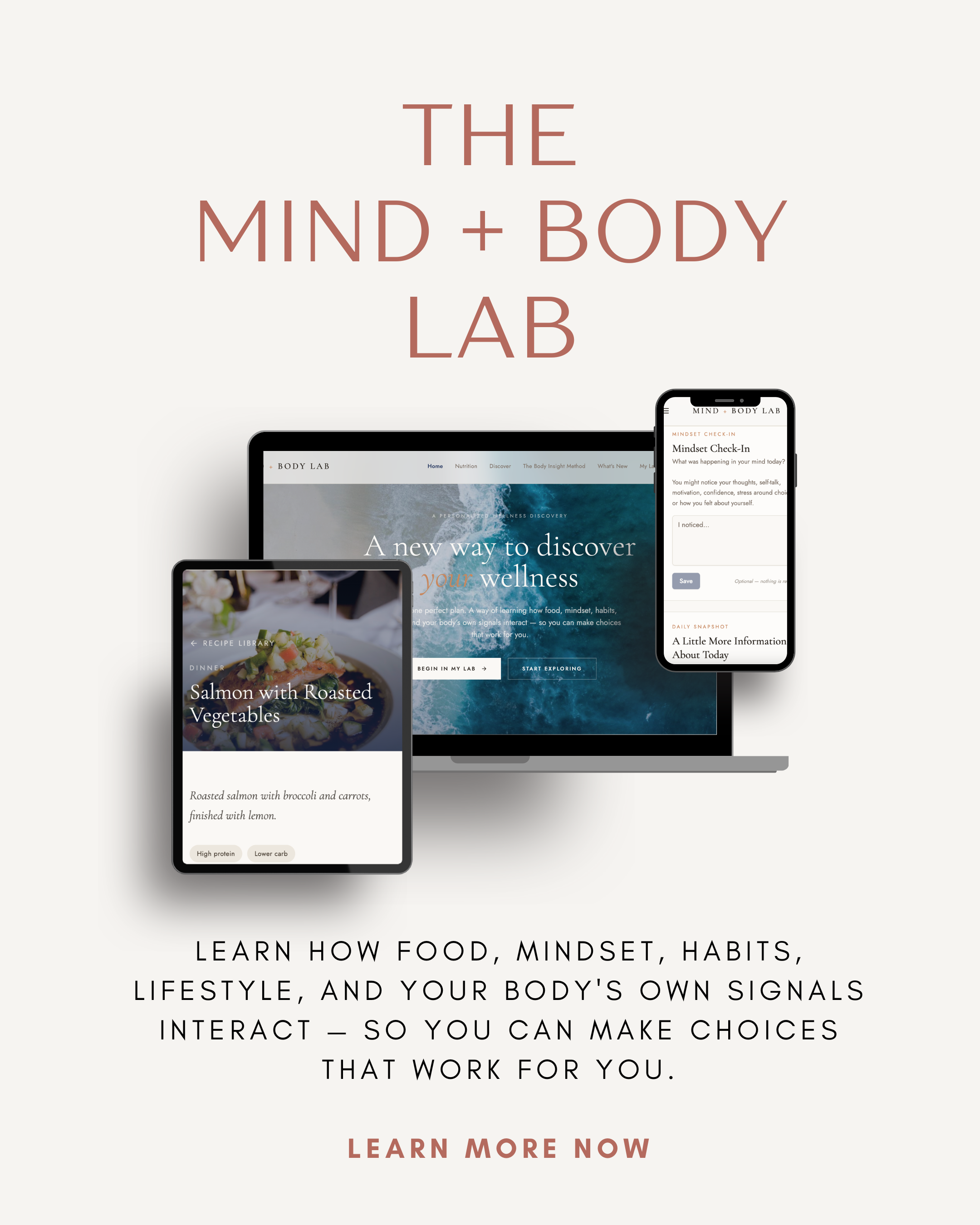
Mind-Body Lab - A guided wellness membership where you'll learn, practice, and grow with monthly education, challenges, and practical wellness tools.
Personalized Wellness Coaching - One-on-one coaching and a personalized plan designed around your body, goals, and lifestyle.
THE MIND + BODY LAB - SAY HELLO TO A NEW WAY TO APPROACH YOUR WELLNESS
A way of learning how food, mindset, habits, lifestyle, and your body's own signals interact — so you can make choices that work for you.
Includes:
Nutrition Pathways (Mediterranean, High Protein, GLP-1 & More - recipes, meal plans & action steps)
Discovery - tools & educations to learn and experiment with. Enjoy topics from mindset (identity, self-talk, limiting beliefs, perfectionism), self-care, habits and motivation to nutrition and eating behaviors.
The Body Insight Method - Learn how to tune into your body & lifestyle to create a wellness plan that works for you.
What’s New (interactive) - A space for our coaches to post weekly topics, reflective thoughts, monthly challenges and more. This is also a place for interaction. You can comment and ask questions to learn more!
My Lab (intuitive + interactive) - Your personal space to practice what you’re learning. Check in, reflect and notice what you’re learning and what’s working (or what isn’t). Let the lab provide helpful tips and pattern recognition to support your wellness & mindset goals.
Get The Mind + Body Lab Today!