




How Self-Talk Can Help You Reach Your Wellness Goals
/
One thing we address at our wellness retreats on a regular basis is self-talk and mindset. One of the most powerful tools for changing your health and well-being is something you already do all day long? You talk to yourself.
Not necessarily out loud. Most of us have a constant stream of thoughts, observations, judgments, expectations and reminders running through our minds.
The way you repeatedly talk to yourself can influence what you believe about yourself, what you pay attention to, the choices you make and the actions you take. That doesn't mean you can simply think your way into a healthier life. Positive thinking isn't a substitute for action.
But the way you think can influence the actions you're willing to take — and over time, those actions can become part of who you are.
Your thoughts can become familiar pathways
This is where neuroplasticity comes into the picture. Your brain is constantly adapting based on your experiences and the patterns you repeat. The familiar saying "neurons that fire together, wire together" is a simple way of describing the idea that repeated patterns of neural activity can become stronger and more established.
You're not necessarily creating an entirely new brain every time you think a new thought. You're strengthening pathways and patterns through repetition.
That's one reason your habitual self-talk matters. If you repeatedly tell yourself:
I'm terrible at taking care of myself.
I have no willpower.
I always give up.
I'll never be consistent.
Those thoughts can become familiar. And when a thought becomes familiar, it can start to feel like a fact rather than simply a thought. But the same principle can work in a different direction. When you repeatedly practice thoughts such as:
I respect myself.
I can take care of my needs.
I am learning to be consistent.
I make choices that support how I want to feel.
You're giving your brain a different pattern to practice. And when those thoughts begin to influence your choices and behaviors, you're no longer just thinking differently. You're doing differently.
Self-talk can influence the brain-body connection
Your thoughts don't exist separately from your body. What you think and expect can influence things like attention, stress, emotional responses and how you interpret physical sensations.
Think about how differently your body can feel when you're telling yourself, I'm overwhelmed. I don't have enough time. Everything is too much compared with I have enough time. I can slow down. I can handle this one thing at a time.
The circumstances may be exactly the same. But your experience of those circumstances can be different. This is part of the reason I don't think wellness is simply about changing what you eat or how often you exercise. It's also about changing the relationship you have with yourself. And sometimes that relationship starts with the words you repeatedly use in your own head.
Affirmations aren't magic
I'm a big fan of affirmations, but probably not for the reason you might expect. I don't think of an affirmation as a magic phrase or a technique that you repeat 20 times and suddenly your life changes. An affirmation is simply a thought you're intentionally practicing.
You're choosing to introduce a different thought into a pattern that may have become automatic.
And then you repeat it. And repeat it. And eventually, that thought can become more familiar.
But here's the part that's really important:
You have to live it, too.
Your thoughts influence your actions, and your actions provide your brain with new evidence. That's where real change can begin.
I experienced this myself
One of the first areas where I intentionally used self-talk was patience. I realized that I was constantly rushing myself. I was taking on too much responsibility, trying to fit too much into my day and then feeling irritated because I never seemed to have enough time.
So I started telling myself:
I am patient.
I am tuned into myself.
I give myself enough time so I don't have to rush.
Nothing dramatic happened overnight. In fact, it took months. I even mentioned to a friend that I didn’t think it was working or that I was actually learning from doing these affirmations.
But then gradually, I noticed that I was changing. I was giving myself enough time to work out. Enough time to get ready. And enough time to leave the house.
I wasn't constantly trying to squeeze one more thing into the day. And I wasn't as irritable. Eventually, I realized that I wasn't just telling myself that I was patient anymore. I was actually behaving like a patient person. The thought had started influencing the behavior.
Another example: self-respect
I also started telling myself:
I respect myself.
I respect my body.
I respect my needs.
I respect my appearance.
Again, this wasn't about convincing myself that everything was perfect. It was about practicing a different way of thinking about myself. And eventually, I started making different choices.
I was eating differently. I was dressing differently. And I was taking better care of myself.
Other people even started noticing and commenting that I looked great. But what was most interesting to me wasn't that other people noticed. It was that I felt different. My choices were becoming more consistent with the way I was learning to see myself.
This is where wellness goals become sustainable
We often think of reaching a goal as a matter of knowing what to do. Eat better. Move more. Get enough sleep. Manage stress. Make time for yourself.
The information isn't usually the problem. The harder part is consistently behaving in a way that supports what you know. And that's where self-talk can become useful.
Instead of starting with:
What do I need to force myself to do?
Try asking:
Who do I want to become?
Maybe you want to become someone who takes care of herself, who listens to her body, who moves because movement makes her feel good, who gives herself enough time, who respects her needs, who follows through. Then start practicing the thoughts that support that identity. Start with thoughts that feel believable enough to practice.
Instead of:
I never procrastinate.
Try:
I'm becoming someone who follows through.
Instead of:
I love everything about my body.
Try:
I am learning to respect my body.
Instead of:
I am perfectly consistent.
Try:
I can practice consistency one choice at a time.
Those thoughts give you somewhere to go. And then your behavior gives your brain evidence.
Think. Believe. Act. Repeat.
For me, this is the part that explains how real change happens.
We think differently.
We begin to believe differently.
We act differently.
And then we repeat it.
The repetition is important because one positive thought isn't going to transform your life. But a thought that is practiced repeatedly, reinforced by your experiences and followed by consistent action can become part of a larger pattern. Eventually, that pattern can begin to feel like you.
That's what happened with my patience and what happened with self-respect. And I've seen it happen in many other areas of my life, too. I can't tell you that every thought you have will become reality (we have wayyy to many thoughts to wrangle them all in). But I can tell you that I'm living proof that what you repeatedly tell yourself can influence what you do — and what you repeatedly do can change your life.
You don't have to completely reinvent yourself overnight. You can start with one thought. Choose one that reflects the person you want to become. Then practice it and let your actions support it. And give your brain time to learn something new.
The idea isn't “here's the perfect affirmation” but learn to observe your patterns, experiment with a different thought, notice what changes, and use your experience as feedback.
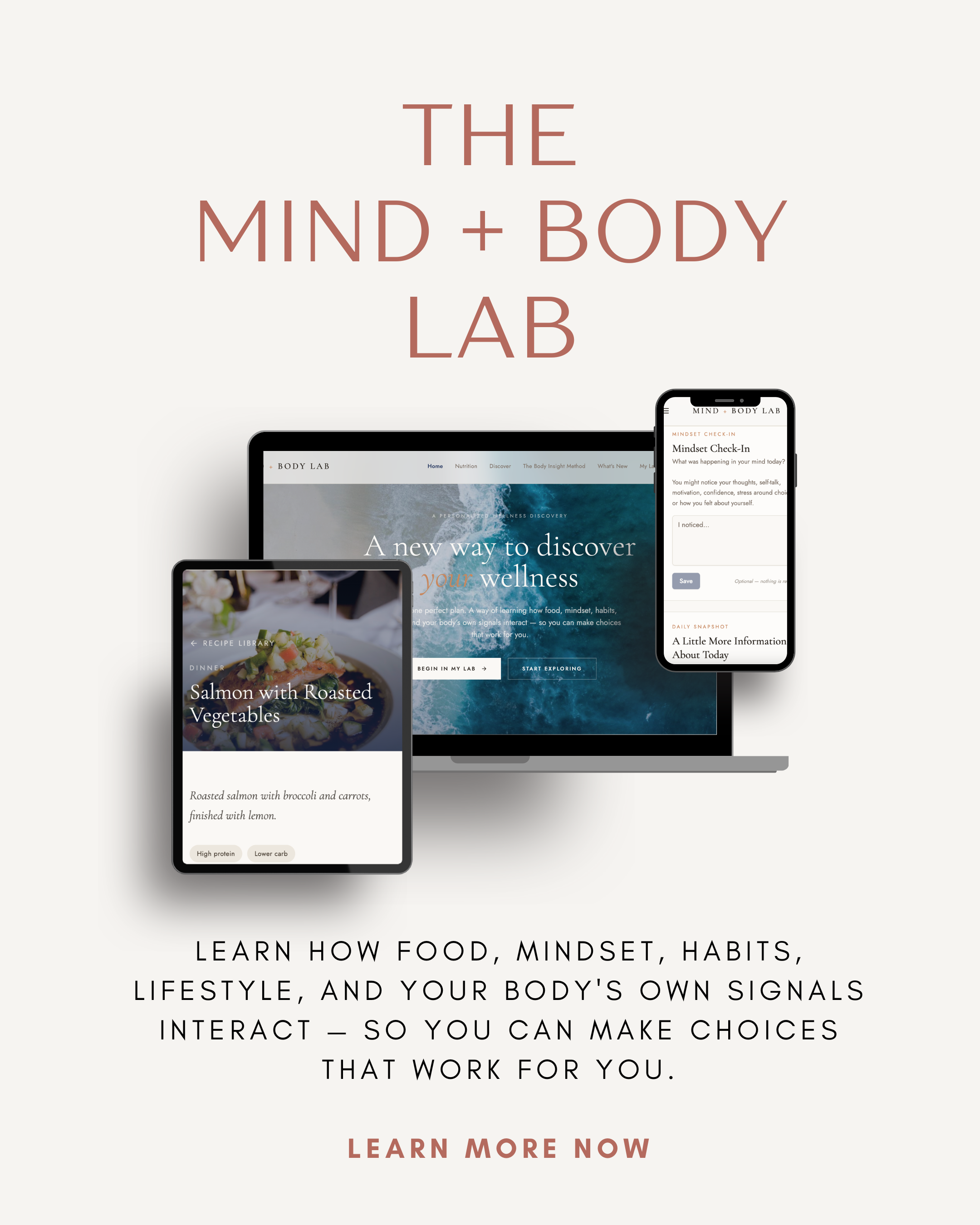
→ Want to go beyond the basics and dive further into wellness? Explore The Mind + Body Lab and discover the tools, guidance, and support to help you create lasting wellness.
Next Steps:
Choose what you want and who you are
Identify where your self-talk has played a role
Choose one or two main themes and come up with an affirmation or two that feel natural for you
Start talking to yourself with this new language
Be consistent with it
Adapt when needed (nothing has to be fixed)
Enjoy the journey!
THE MIND + BODY LAB - SAY HELLO TO A NEW WAY TO APPROACH YOUR WELLNESS
A way of learning how food, mindset, habits, lifestyle, and your body's own signals interact — so you can make choices that work for you.
Includes:
Nutrition Pathways (Mediterranean, High Protein, GLP-1 & More - recipes, meal plans & action steps)
Discovery - tools & educations to learn and experiment with. Enjoy topics from mindset (identity, self-talk, limiting beliefs, perfectionism), self-care, habits and motivation to nutrition and eating behaviors.
The Body Insight Method - Learn how to tune into your body & lifestyle to create a wellness plan that works for you.
What’s New (interactive) - A space for our coaches to post weekly topics, reflective thoughts, monthly challenges and more. This is also a place for interaction. You can comment and ask questions to learn more!
My Lab (intuitive + interactive) - Your personal space to practice what you’re learning. Check in, reflect and notice what you’re learning and what’s working (or what isn’t). Let the lab provide helpful tips and pattern recognition to support your wellness & mindset goals.
Get The Mind + Body Lab Today!